Showing posts with label Religious. Show all posts

Tuesday, January 14, 2014

Happy Pongal

          Pongal is a Hindu festival which is observed by people of Tamil Nadu. Pongal is a four days festival and the most important day of Pongal is known as Thai Pongal. Thai Pongal which is the second day of the four days festivity is also celebrated as Sankranti.
              The first day is called Bhogi. Many people burn and get rid of old household items and purchase new household items on this day. This marks the start of a new cycle.
                   Thai Pongal day is celebrated by boiling freshly harvested rice with fresh milk and jaggery in a new clay pot. While boiling the concoction, people let the milk spill over the pot as an auspicious sign of material abundance and prosperity. Later the concoction of rice, milk and jaggery, known as Pongal, is topped with brown sugar, Ghee, cashew nuts and raisins. Many people worship the sun god, Lord Surya by offering prayers on this day. Many people also wear new clothes and women decorate houses with Kolam(designs) using rice flour and red clay.
                  Next day of Thai Pongal is known as Mattu Pongal. Cattles are decorated and worshipped on Mattu Pongal day. The last and final day of Pongal is known as Kaanum Pongal. It is time for family reunions in Tamil Nadu.
                Pongal has many regional names. The most popular variations are:Makar Sankranti,Lohri,Bihu,Hadaga,Poki.


Here is the recipe for Ven pongal. Enjoy :)

Sunday, March 17, 2013

St. Patrick's Day

              Saint Patrick's Day or the Feast of Saint Patrick (Irish: Lá Fhéile Pádraig, "the Day of the Festival of Patrick") is a cultural and religious holiday celebrated on 17 March. It is named after Saint Patrick (c. AD 385–461), the most commonly recognised of the patron saints of Ireland.

Things You Didn't Know
1.No doubt you'll be seeing the color green everywhere today in honor of the patron saint of Ireland, St. Patrick. Here's a look at five things you didn't know about St. Patrick's Day

2.St. Patrick Was Not Irish -His birth name was actually Maewyn Succat -- it wasn't until he was in the Church that it was changed to Patricius, or Patrick. St. Patrick, the Apostle of Ireland, was born in Kilpatrick, near Dumbarton, which is in Scotland. As a teenager, he was kidnapped by Irish raiders and enslaved as a shepherd for several years. He attributed his ability to persevere to his faith in God.

3.Did St. Patrick Drive All the Snakes Out of Ireland?
Despite the popular lore, St. Patrick did not drive the snakes out of Ireland because the island did not have any to begin with. Icy water surrounds the Emerald Isle, which prevented snakes from migrating over.

4.Green may be the national color of Ireland, but the color most associated with St. Patrick is blue. The Order of St. Patrick was established in 1783 as the senior order of chivalry in the Kingdom of Ireland. The color associated with the honor needed to differentiate it from the Order of the Garter (dark blue) and the Order of the Thistle (green). So they went with blue.

5.The first St. Patrick's Day parade was held in the U.S. The Irish have been celebrating the feast of St. Patrick since the ninth century, but the first recorded parade anywhere was in Boston in 1737. The parade was not Catholic in nature, though, because the majority of Irish immigrants to the colonies were Protestant. Ireland did not have a parade of its own until 1931, in Dublin. Even today, 18 out of the 20 largest St. Patrick's Day parades are in the states -- New York's is the largest.

6.St. Patrick used a three-leafed shamrock to explain the Holy Trinity to pagan Irish, forever linking the shamrock with him and the Irish in the popular imagination. He would tie shamrocks to his robes, which is why the color green is worn.


Wishing you a rainbow
For sunlight after showers

Miles and miles of Irish smiles
For golden happy hours

Shamrocks at your doorway
For luck and laughter too,

And a host of friends that never ends
Each day your whole life through!

Wednesday, September 12, 2012

Cathedral Basilica of Saints Peter and Paul - Philadelphia

               Francis Patrick Kenrick initiated the building of this magnificent Church in 1846. It was continued through the tenure of Saint John Neumann and completed in 1864 by Bishop (later Archbishop) Wood. The Cathedral Basilica of Saints Peter and Paul is modeled after the Lombard Church of Saint Charles (San Carlo al Corso) in Rome. It is an excellent example of Roman-Corinthian architecture. 
      With its majestic facade, vaulted dome, ornate main altar, eight impressive side chapels, and main sanctuary the Cathedral Basilica of Saints Peter and Paul is one of the largest brownstone and architecturally-eminent structures in the City of Philadelphia. The Cathedral of Saints Peter and Paul is ranked among the outstandingly beautiful and architecturally perfect structures in Philadelphia and in the United States.


Thursday, August 2, 2012

Raksha Bandhan

                   August 2 is Raksha Bandhan,the festival celebrates the bond between a brother and a sister.Raksha Bandhan is a popular festival in India, especially North India. The festival depicts the love of brothers and sisters. On this day sisters tie a thread called 'Rakhi' around her brother's wrist. She prays to God for the safety of her brother and to lead him to good path.The brother in return gives her sweets and blesses her with good wishes. The festival should not be celebrated as a formality but should be celebrated whole heartedly.
          The festival is held on Shravan Purnima, or the full moon day of the month of Shravan. When a brother arrives at his sister's house (presuming she is married), she greets him by performing an aarti for him and applying a tika on his forehead by using kumkum. The puja thali she holds in her hand consists of roli, tilak, rakhi thread, a small heap of rice grains and sweets. As she ties the rakhi on her brother's wrist, she recites:
      "Suraj shakhan chhodian, mooli chhodia beej, behen ne rakhi bandhi /bhai tu chir jug jee"

(Meaning: The sun radiates its sunlight, the radish spreads its seeds, I tie the rakhi to you O brother and wish that may you live long.)
The mantras recited during rakhi may differ from place to place but the theme is the same.

                 There are some who trace the tradition to Alexander the Great, who invaded India in 326 BC. His wife Roxana apparently sent a sacred thread to Puru, asking him not to harm her husband in battle. In accordance with tradition, Puru, a Katoch king, gave full respect to the thead, or rakhi. On the battlefield, when he was about to deliver a final blow to Alexander, he allegedly looked at the rakhi on his own wrist and restrained himself.

                      There is another legend associated with rakhi. Apparently, in the 16th century, Queen Karnavati, the widowed queen of Chittor, sent a rakhi to Mughal emperor Humayun when she required his help.
                         The symbolism of a simple thread to drive home a message was not lost on famous Bengali poet Rabindranath Tagore, who apparently composed a poem called ''Rakhi'' in 1905 and marched through Calcutta with freedom fighters like Bal Gangadhar Tilak and Aurobindo Ghosh, tying rakhis on people's hands with a prayer for keeping Bengal unified.

Thursday, May 3, 2012

WHY TO VISIT TEMPLES ?

                 There are thousands of temples all over India in different size, shape and locations but not all of them are considered to be built by the Vedic way. Generally, a temple should be located at a place where earth's magnetic wave path passes through densely. It can be in the outskirts of a town/village or city, or in middle of the dwelling place, or on a hilltop. The essence of visiting a temple is discussed here.

            Now, these temples are located strategically at a place where the positive energy is abundantly available from the magnetic and electric wave distributions of north/south pole thrust. The main idol is placed in the core center of the temple, known as "*Garbhagriha*" or *Moolasthanam*. In fact, the temple structure is built after the idol has been placed. This *Moolasthanam* is where earth’s magnetic waves are found to be maximum. We know that there are some copper plates, inscribed with Vedic scripts, buried beneath the Main Idol. What are they really? No, they are not God’s / priests’ flash cards when they forget the *shlokas*. The copper plate absorbs earth’s magnetic waves and radiates it to the surroundings. Thus a person regularly visiting a temple and walking clockwise around the Main Idol receives the beamed magnetic waves and his body absorbs it. This is a very slow process and a regular visit will let him absorb more of this positive energy. Scientifically, it is the positive energy that we all require to have a healthy life.

                   Further, the Sanctum is closed on three sides. This increases the effect of all energies. The lamp that is lit radiates heat energy and also provides light inside the sanctum to the priests or *poojaris* performing the pooja. The ringing of the bells and the chanting of prayers takes a worshipper into trance, thus not letting his mind waver. When done in groups, this helps people forget personal problems for a while and relieve their stress. The fragrance from the flowers, the burning of camphor give out the chemical energy further aiding in a different good aura. The effect of all these energies is supplemented by the positive energy from the idol, the copper plates and utensils in the *Moolasthanam* / *Garbagraham*. *Theertham*, the holy water used during the pooja to wash the idol is not plain water cleaning the dust off an idol. It is a concoction of Cardamom,*Karpura* (Benzoin), zaffron / saffron, *Tulsi* (Holy Basil), Clove, etc...Washing the idol is to charge the water with the magnetic radiations thus increasing its medicinal values. Three spoons of this holy water is distributed to devotees. Again, this water is mainly a source of magneto-therapy. Besides, the clove essence protects one from tooth decay, the saffron & *Tulsi* leafs protects one from common cold and cough, cardamom and *Pachha Karpuram* (benzoin), act as mouth fresheners. It is proved that *Theertham* is a very good blood purifier, as it is highly energized. Hence it is given as *prasadam* to the devotees. This way, one can claim to remain healthy by regularly visiting the Temples. This is why our elders used to suggest us to offer prayers at the temple so that you will be cured of many ailments. They were not always superstitious. Yes, in a few cases they did go overboard when due to ignorance they hoped many serious diseases could be cured at temples by deities. When people go to a temple for the *Deepaaraadhana*, and when the doors open up, the positive energy gushes out onto the persons who are there. The water that is sprinkled onto the assemblages passes on the energy to all. This also explains why men are not allowed to wear shirts at a few temples and women are requested to wear more ornaments during temple visits. It is through these jewels (metal) that positive energy is absorbed by the women. Also, it is a practice to leave newly purchased jewels at an idol’s feet and then wear them with the idol’s blessings. This act is now justified after reading this article. This act of “seeking divine blessings” before using any new article, like books or pens or automobiles may have stemmed from this through mere observation.

Energy lost in a day’s work is regained through a temple visit and one is refreshed slightly. The positive energy that is spread out in the entire temple and especially around where the main idol is placed, are simply absorbed by one's body and mind. Did you know, every Vaishnava(Vishnu devotees), must visit a Vishnu temple twice every day in their location. Our practices are not some hard and fast rules framed by 1 man and his followers or God’s words in somebody’s dreams. All the rituals, all the practices are, in reality, well researched, studied and scientifically backed thesis which form the ways of nature to lead a good healthy life.

The scientific and research part of the practices are well camouflaged as “elder’s instructions” or “granny’s teaching’s” which should be obeyed as a mark of respect so as to once again, avoid stress to the mediocre brains.


Saturday, April 14, 2012

Happy Vishu


Vishu marks the beginning of Malayalam New Year, the beginning of hope and new life.Vishu is the astrological new year of Kerala. Vishu conveys the message of auspiciousness and prosperity. Vishukkani or the viewing of the auspicious objects is an important ritual associated with Vishu.
                 we celebrate the harvest festival, Vishu today.I woke up this morning around 4 am.Headed toward the living room with my eyes closed and there it was – the Vishu kani lit with lamps shining so bright everything so bright and colorful.. This propitious 'seeing ceremony' is a harbinger of health, happiness, peace and prosperity and set the tone for the year ahead. Of course ,then I received my "Vishukkaineettom". Crackers are not allowed here. But we can use them in some temples.
          It is the custom for people to wake up at dawn on Vishu and to go to the puja room with their eyes closed so that the first thing that they see in the new year is the Vishukkani.  People also celebrate by wearing new clothes, lighting firecrackers and feasting.                         
                  For me it’s a festival of nostalgic memories  and they are invariably associated with my childhood. Those memories are as golden as the 'Kani Konna flower'.


Happy Vishu! Let this be a delightful year, filled with delightful things in each of its days.


Friday, April 13, 2012

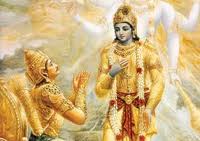
Bagavad gita quotes


"Man is made by his belief. As he believes, so he is"

"Neither in this world nor elsewhere is there any happiness in store for him who always doubts."

"The mind is restless and difficult to restrain, but it is subdued by practice."

"A person on the spiritual path should try to be non-envious, friendly and compassionate towards all living entities; he should be non-possessive, free from false ego, same in happiness and distress, and forgiving towards all "

"Those who eat too much or eat too little, who sleep too much or sleep too little, will not succeed in meditation. But those who are temperate in eating and sleeping, work and recreation, will come to the end of sorrow through meditation."

"The soul who meditates on the Self is content to serve the Self and rests satisfied within the Self; there remains nothing more for him to accomplish."

"Better indeed is knowledge than mechanical practice. Better than knowledge is meditation. But better still is surrender of attachment to results, because there follows immediate peace."


"When meditation is mastered, the mind is unwavering like the flame of a lamp in a windless place."

"Fear not what is not real, never was and never will be. What is real, always was and cannot be destroyed."

                                                 "Hari Om"


Thursday, April 12, 2012

The Story of the Shiva Lingam


  Shiva had no sense in the transitory pleasures of life, so he rejected samsara, smeared his body with ash, closed his eyes and performed austerities. Shiva's tapas generated so much heat that his body transformed into a pillar of fire - a blazing lingam that threatened to destroy the whole world. The gods did not know how to control Shiva's fire. Suddenly there appeared a yoni - the divine vessel of the mother-goddess. It caught the fiery lingam and contained its heat, thus saving the cosmos from untimely destruction.


  Shiva is often pictured in a pacific mood with his consort Parvati, as the cosmic dancer Nataraja, as a naked ascetic, as a mendicant beggar, as a yogi Dhakshinamurthy, and as the androgynous union of Shiva and Parvati in one body (Ardhanarisvara). Shiva also takes the form of Ardhanari, his androgynous form. The right side of the sculpture is Shiva and the left side is Parvati. The attributes of each are split directly down the middle.


Another example of Shiva's apparent synthesis of male and female attributes is seen in his earrings. He wears one earring in the style of a man and the other as a female as shown in the two different earrings Shiva wears.The third eye is a symbol of higher consciousness. It is also something with which he can destroy his enemies "with fire." He can also kill all the gods and other creatures during the periodic destruction of the universe. Shiva's third eye first appeared when Parvati, his wife, playfully covered his other two eyes, therefore plunging the world into darkness and putting it in danger of destruction.

Sunday, April 8, 2012

Easter

         Easter, which celebrates Jesus Christ's resurrection from the dead, is Christianity's most important holiday. It has been called a moveable feast because it doesn't fall on a set date every year, as most holidays do.
    Easter is usually celebrated on the first Sunday after the full moon following the Vernal or Spring Equinox on March 21st. This can be any Sunday between March 22nd and April 25th. It is the most sacred of all the Christian holidays or celebrations.
       Christ's return (or rising) from death is called the Resurrection. According to the scriptures, Christ's tomb was empty three days after His death, which is commemorated on Good Friday. His followers saw Him and talked to Him after this. Christians therefore believe that they have the hope of a new life (an everlasting life in Heaven) after their earthly death.
       People celebrate Easter according to their beliefs and their religious denominations.Easter customs vary across the Christian world, but decorating Easter eggs is a common motif. In the Western world, customs such as egg hunting and the Easter Bunny extend from the domain of church, and often have a secular character.

May your Easter be blessed with health, longevity, love and a lot of happiness..
                 Happy Easter

Saturday, April 7, 2012

Holy Saturday

Holy Saturday , sometimes known as Easter Eve or Black Saturday, is the day after Good Friday. It is the day before Easter and the last day of Holy Week in which Christians prepare for Easter. It commemorates the day that Jesus Christ's body laid in the tomb.

Friday, April 6, 2012

Good Friday

Good Friday is observed on the Friday before Easter Sunday. It is celebrated traditionally as the day on which Jesus was crucified.This is an important event in Christianity, as it represents the sacrifices and suffering in Jesus' life. The crucifixion was the culmination of a number of events in Holy Week, including: the triumphal return of Jesus to Jerusalem on Palm Sunday; the washing of the disciples' feet by Jesus; and the Last Supper on Maundy Thursday.
Good Friday is a day of mourning and quiet prayer for many Christians. The candles are often extinguished and statues, paintings and crosses may be draped in black, purple or gray cloth.
Good Friday is not an official holiday in United States.

Pournami (poornima- Full moon day )

          Poornima (Full moon day) is an auspicious day in Hinduism. Many important rituals and festivals takes place on full moon day. In South India, the day is known as Pournami. Upavaasam  (Fasting) is observed on this day by some people. The Poornima Fasting begins at Sunrise and ends after seeing the Moon. Most people only take food after seeing the moon or after evening Pooja. In some places in South India, the Pournami Vratam is dedicated to Devi, Mother Goddess. Special Poojas are performed in temples on Poornima day . Satya Narayana Puja is another important Pooja performed on the Poornima day.

Thursday, April 5, 2012

Maundy Thursday

Maundy Thursday, also known as Holy Thursday, Covenant Thursday, Great and Holy Thursday, and Thursday of Mysteries, is the Christian feast or holy day falling on the Thursday before Easter that commemorates the Last Supper of Jesus Christ with the Apostles as described in the Canonical gospels. It is the fifth day of Holy Week, and is preceded by Holy Wednesday and followed by Good Friday.

Wednesday, April 4, 2012

Holy Wednesday


           Holy Wednesday is the Wednesday of the Holy Week, the week before Easter. It is followed by Maundy Thursday.It is sometimes known as "Spy Wednesday",as a reference to the betrayal of Jesus by Judas Iscariot, indicating that it is the day that Judas Iscariot first conspired with the Sanhedrin to betray Jesus for thirty silver coins :(.

Tuesday, April 3, 2012

Who is the Easter Bunny?

          On Easter Sunday, many children wake up to find that the Easter Bunny has left them baskets of candy. He has also hidden the eggs that they decorated earlier that week. Children hunt for the eggs all around the house. Neighborhoods and organizations hold Easter egg hunts, and the child who finds the most eggs wins a prize.
The Easter Bunny is a rabbit-spirit. Long ago, he was called the "Easter Hare", hares and rabbits have frequent multiple births so they became a symbol of fertility. The custom of an Easter egg hunt began because children believed that hares laid eggs in the grass. The Romans believed that "All life comes from an egg." Christians consider eggs to be "the seed of life" and so they are symbolic of the resurrection of Jesus Christ.

Monday, April 2, 2012

Easter Egg

          Easter eggs are special eggs that are often given to celebrate Easter or springtime.
The oldest tradition is to use dyed or painted chicken eggs, but a modern custom is to substitute chocolate eggs, or plastic eggs filled with confectionery such as jelly beans. These eggs can be hidden for children to find on Easter morning, who may be told they were left by the Easter Bunny. They also may be put in a basket filled with real or artificial straw to resemble a bird's nest.
 The purpose of this is to include one and all in the joyous Easter celebrations and to spread happiness and goodwill among everyone.

Sunday, April 1, 2012

Palm Sunday

                   Palm Sunday is a Christian moveable feast that falls on the Sunday before Easter. It is the beginning of Holy Week. It celebrates Jesus' triumphant entry into Jerusalem on the back of a donkey. Great crowds of people thronged the streets waving palm branches to welcome Him. The people shouted "Hosanna" and laid their cloaks and palm branches from the nearby trees in His path.

Story of palm Sunday 
    The morning after the supper at Bethany, Jesus called two of his disciples and said to them, "Go into the next village, and at a place where two roads cross, and there you will find an ass tied, and a colt with it. Loose them, and bring them to me. And if anyone says to you, 'Why do you do this?' say 'The Lord has need of them,' and they will let them go."
They went to the place, and found the ass and the colt, and were loosing them, when the owner said, "What are you doing, untying the ass?" And they said, as Jesus had told them to say, "The Lord has need of it!"
     Then the owner gave them the ass and the colt for the use of Jesus. They brought them to Jesus, on the Mount of Olives, and they laid some of their own clothes on the colt for a cushion, and set Jesus upon it. Then all the disciples and a very great multitude threw their garments upon the ground for Jesus to ride upon. Others cut down branches from the trees and laid them on the ground.
                       And as Jesus rode over the mountain toward Jerusalem many walked before him waving branches of palm-trees. And they all cried together, "Hosanna to the Son of David! Blessed is he that cometh in the name of the Lord! Blessed be the kingdom of our father David, that cometh in the name of the Lord! Hosanna in the highest!"
     These things they said because they believed that Jesus was the Christ, the Anointed King, and they hoped that he would now set up his throne in Jerusalem. Some of the Pharisees in the crowd, who did not believe in Jesus, said to him, "Master, stop your disciples!" But Jesus said, "I tell you, that if these should be still, the very stones would cry out!"
                And when he came into Jerusalem with all this multitude, all the city was filled with wonder. They said, "Who is this?" And the multitude answered, "This is Jesus, the prophet of Nazareth in Galilee!"
                  And Jesus went into the temple, and looked around it; but he did not stay, because the hour was late. He went again to Bethany, and there stayed at night with his friends.
        These things took place on Sunday, the first day of the week; and that Sunday in the year is called Palm Sunday, because of the palm branches which the people carried before Jesus.
 

Palm Sunday is marked by the distribution of palm leaves to the assembled worshipers.

Saturday, March 31, 2012

Holy Week

            The Holy week is the last week of Lent. It begins with the observance of Palm Sunday, the Sunday before Easter Sunday. The name, Palm Sunday originated from Jesus's entry in Jerusalem. The crowd laid carpets of palms on the street for Him. The Last Supper is commemorated on Holy Thursday of special week (often called Maundy Thursday) and Friday is the anniversary of the crucifixion of Jesus Christ on the cross. The Lenten season and Holy week end with Easter Sunday.

Friday, March 30, 2012

Holy Lent


      Lent is the forty days special season prior to Easter Sunday. Sundays are not counted because it is the Lord's Day and should be celebrated and therefore no fasting. Lent is a period of fasting or doing without certain foods, praying and repentance. This is to serve as a reminder of the forty days Jesus fasted in the wilderness. 


Sunday, February 19, 2012

Happy Shivaratri

Oh Lord of the Lords... grant peace & prosperity to the entire mankind. Show the correct and right path to each & every human being in this universe..  
Today is the auspicious day of Lord Shiva. Celebrate it with joy of heart and help people understand the values of Lord Shiva.